
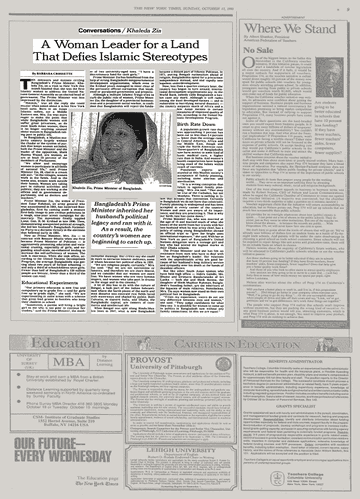
Conversations: Khaleda Zia; A Woman Leader for a Land That Defies Islamic Stereotypes
By Barbara Crossette/ The New York Times/Oct 17, 1993
THE ministers and minions circling Bangladesh’s Prime Minister, Khaleda Zia, on a visit to New York this month boasted that she was the first Islamic woman to address the United Nations General Assembly as an elected head of government. The Prime Minister was less impressed by the distinction.
“Hmmm,” was all the reply she could muster when asked about it in her New York hotel suite. Born in an Asian Islamic milieu, not a Middle Eastern one, Mrs. Zia was more eager to make the point that while Bangladeshi women still suffer great privations, as do most South Asian women, there is no longer anything unusual about women in Bangladesh taking part in public life.
In Bangladesh, a Muslim-majority country largely without the chador or the system of purdah that keeps women secluded, both the Prime Minister and the leader of the opposition, Sheik Hasina Wazed, are women, as are at least 10 percent of the members of Parliament.
“We allow and encourage women to participate in all fields of national life,” said Prime Minister Zia, 48, clad in a cream silk sari. “In the villages, women work in the fields. And in the towns also, women work outside their homes. Women are taking part in cultural activities and politics; they are working in the offices and in government departments, and as doctors and teachers.”
Prime Minister Zia, the widow of President Ziaur Rahman, an army general who was assassinated in 1981, has surprised Bangladeshis, first by casting aside a demure first-lady image to join civilian politicians in a tough, nine-year street campaign for democracy. The movement finally toppled Lieut. Gen. H. M. Ershad in late 1990. Then, demonstrating unexpected political strength, she led her husband’s Bangladesh Nationalist Party to a decisive victory in the elections that followed early in 1991.
Now as Prime Minister, Mrs. Zia — in contrast with Benazir Bhutto when she first became Prime Minister of Pakistan — is aggressively promoting education and vocational training, especially of girls, and expanding small-scale, no-collateral lending to increase the self-sufficiency of women. The task is enormous. When she took office, according to the United Nations Development Program, the average Bangladeshi was getting about two years of formal schooling — and only a third of schoolchildren were girls. Fewer than half of Bangladesh’s 120 million people are literate; fewer than a third of the women can read. Educational Experiments
“Our primary education is now free and compulsory up to grade five — and for girls free up to grade eight,” she said. “We are experimenting in some areas with a scheme that gives food grains to families who keep their children in school.
“Sometimes, a parent will bring a bright girl to me who is too poor to continue her studies,” said the Prime Minister, the mother of two university-aged sons. “I have a discretionary fund for such girls.”
Prime Minister Zia has benefitted from the help of strong Bangladeshi nongovernmental development organizations, which even in the Ershad years managed to steer clear of the pervasive official corruption that weakened or paralyzed government aid projects.