
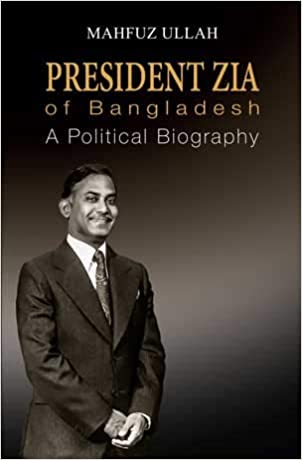
President Zia of Bangladesh
Zia became an icon of Bangladesh the moment his voice went on air on 27 March 1971 from the Kalurghat Radio Station at Chittagong. As soon as that four-word opening sentence, ‘I Major Zia speaking’, was heard on the radio, it had an electrifying effect on the people seeking exit from Pakistan. His brief announcement, of just a few sentences, came as a ray of hope for the people exposed to the brutal atrocities of the Pakistani occupation army. “This announcement [of independence] catapulted [the name of] an obscure Major in every household of the country.” …Under a clear blue sky the avenues and streets of Dhaka, capital of Bangladesh, turned into a vast sea of people, who were standing under a sweltering sun with their hearts broken and eyes tearful. Only their heads were visible, so thick was the crowd. They came to bid farewell to their friend, guide and philosopher, President Ziaur Rahman, who was assassinated in the early hours of 30 May 1981 at Chittagong, from where he had given a clarion call to the nation to take up arms for independence a decade ago in 1971. ..”During the janaza, the chanting of the Moslem last rites for the departed soul, a crowd extending beyond the horizon turned as one toward Mecca and sobbed the mournful prayer. As the procession moved towards the Crescent Lake, people climbed tress to toss flowers upon the bier,” reported one foreign daily. Zmur Rahman is a historic figure in Bangladesh, in part because he has established the nation\’s first effective government but primarily because of his efforts to build institutions that can carry forward a new concept of Bangladeshi nationalism. Zia wants people to be enthusiastic about building up the country. He wants them to be vigilant and prepared to resist, militarily if necessary pressures from outside. He wants people to have confidence that that they can grow things themselves, without relying on foreigners. He wants them to have pride in their religion, and to have no problems with