
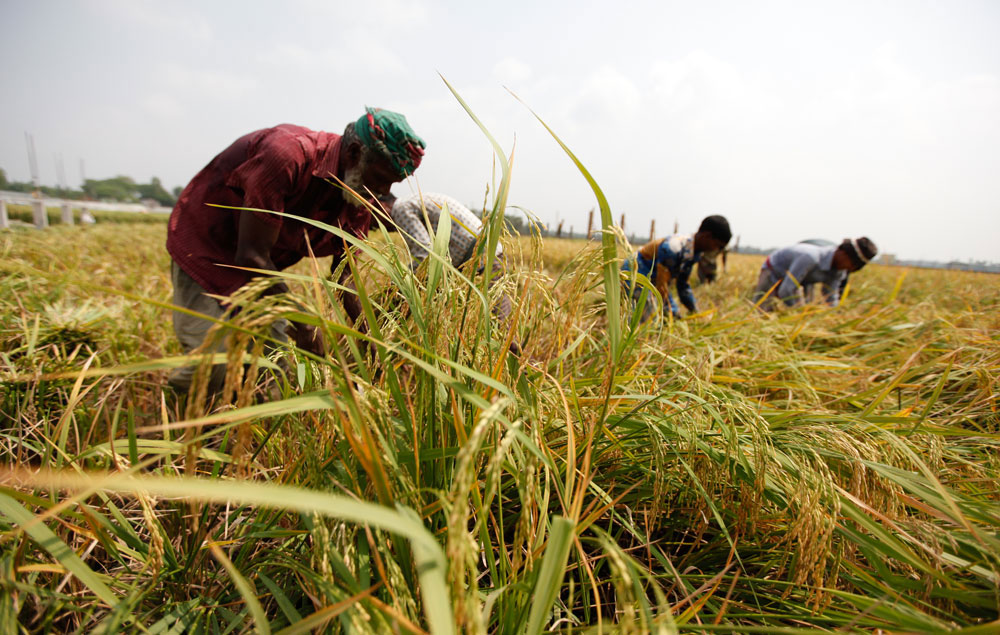
Peasants and Agriculture
133. Keeping in view high population density and shrinking agricultural land, innovative agricultural strategy shall be adopted. Crop zoningshall be encouraged considering the suitability of cultivation of particular crops for the plains, hills and ‘haor-baor’ areas. Peasants will be enthused to cultivate HYV and high value crops. Appropriate marketing policy will be adopted to sustain farmers’ effort in this direction. Canal digging and river training activities shall be strengthened to ensure irrigation and removal of water logging.
134. BNP is committed to the development agriculture and the peasantry. Due to various types of market manipulation peasants do not get fair price for their crops. An appropriate blending of price-support and input subsidy policies shall made to enable farmers get fair price for their products. Data-base will be built up in every union parishads to channelize support to the deserving farmers. A database of the farmers deserving state support shall be created through open meeting at every union parishad.
135. Non availability of quality seeds is a serious problem for Bangladesh agriculture. In order to solve this problem seed multiplication farms and seed processing centers shall be set up in every upa-zilla. As the farmers would be getting benefit from this, total output will grow up by 8% to 10%.
136. Agricultural wages go up in the busy seasons due to shortage of agricultural labor at a specific time. Therefore, cost of agricultural production also goes up. With a view to easing labor shortage situation, incentives will be provided to produce appropriate agricultural tools. Non-farm employment will be created to absorb surplus agricultural labor in the slack season.
137. Peasants do not get fair price for their products as they do not have any control over the marketing process. Handling, sorting, storage and transport facilities will be brought under farmers’ control through creation of vertical co-operative societies and necessary state support will be given to this end.
138. Modern agriculture is highly research dependent. Invention of new varieties of HYV seeds, salinity resistant seeds, less thirsty crops, shortening maturity period of crops, pest resistant crops, multiple cropping within one season and more than one season and input saving crops etc. will be the goal of setting up modern research stations for agriculture. A reasonable portion of the state budget will be ear-marked for agricultural research.
139. Miniscule holding size of Bangladesh agriculture has put a limit on the scope of commercialization of Bangladesh agriculture. This will further intensify in future. This problem can be overcome through technological innovations. Necessary state initiatives shall be undertaken to this end. Commercial farming subjects the farmers to vagaries of market. State shall adopt creative measures to protect the farmers from market-vagaries.
140. Agriculture is highly prone to different types of risk. In order to face this problem crop insurance, live-stock insurance, fisheries insurance and poultry insurance will be introduced, if required, with subsidy.
141. Interest on agricultural loan for poor peasants and natural disaster affected peasants will be given waver.
142. Necessary regulatory mechanism shall be developed to ensure supply and manufacture of safe poultry and fish feed.Protection measures against epidemic diseases like bird-flu shall be ensured. For recycling of poultry feathers and excreta, soft-term credit facilities will be ensured.
143. Comprehensive research initiatives will be undertaken for the development of poultry, fisheries, live-stock, agricultural crops and forest resources.
144. In every Upazilla, veterinary doctors will be appointed and adequate supply of veterinary medicine shall be ensured.
145. Private sector will be given incentives for developing goat, cattle and buffalofarms.
146. Private sector will be given incentive to set up agro-processing industries.
147. Non-agricultural use of agricultural land will be stopped. In order to achieve this goal clustered housing scheme will be undertaken in the rural areas.
148. The main objective of agricultural development will be to ensure food and nutrition security. To ensure balanced and safe nutritious food (calorie, protein, vitamins, minerals, fat etc) the agriculture sector will be totally reorganized and flourished through appropriate incentives. Use of unsafe and harmful manure and pesticides shall be stopped.
149. Shahid President Ziaur Rahman took the first initiative to develop the haors and the life and livelihood of people living in the haor areas through establishment of Haor Development Board on 22nd February, 1977. We must think anew about haor-economy, the haor people, and the haor environment. Planned and multi-dimensional initiatives will be taken to encourage short-lived crops cultivation, aquatic agriculture, planned irrigation, establishment of fish sanctuary, planned duck farming, providing subsidy to the fishermen in hard days, to bring the entire haor under a planned tourism development scheme. To conserve and develop the flora and fauna of the haors, and to utilize the extensive possibilities of the haor areas in both dry and wet season, well designed measures shall be taken.